
If you’re wondering how to take care of your curly hair at home, you’re in the right place. Curly hair is one of the most beautiful and versatile hair types in the world — but it can also be one of the most misunderstood. With the right routine and a little patience, you can transform your curls from frizzy and dry to defined, bouncy, and full of life, all from the comfort of your own home. Or, if you’re ready to let the experts handle it, book a professional curl treatment at Hamzafied.
Understanding Your Curl Type
Before diving into a care routine, it’s essential to understand your specific curl pattern. Curly hair is generally classified into three main categories: Type 2 (wavy), Type 3 (curly), and Type 4 (coily or kinky). Each type has sub-categories (A, B, C) that range from loose to tighter patterns.
Knowing your curl type helps you choose the right products and techniques. For example, Type 2 wavy hair tends to get weighed down easily by heavy creams, while Type 4 coily hair needs much richer moisturizers to prevent breakage. Take a moment to look at your hair when it’s fully dry and product-free to identify your natural pattern.
💡 Pro Tip: When in doubt, focus on your hair’s porosity (how well it absorbs and retains moisture) rather than just your curl pattern — it’s often a better predictor of which products will work for you.
How to Take Care of Your Curly Hair at Home: The Washing Routine
The foundation of how to take care of curly hair at home starts with getting your washing routine right. Unlike straight hair, curly hair is naturally drier because the curl pattern makes it harder for sebum (your scalp’s natural oil) to travel down the hair shaft. This means over-washing can strip your curls of vital moisture.
How Often Should You Wash Curly Hair?
Most curl experts recommend washing curly hair no more than two to three times per week, though many people with Type 4 hair do well with just once a week. Between wash days, use water or a light refresher spray to revive your curls without stripping them.
- Wet your hair thoroughly before applying shampoo. Cold or lukewarm water is best as hot water can cause frizz and dryness.
- Apply a sulfate-free shampoo only to your scalp. Use your fingertips (not nails) to massage in circular motions to stimulate circulation without tangling the lengths.
- Let the suds rinse through the lengths as you rinse — there is no need to scrub the ends directly, which can cause unnecessary friction and frizz.
- Follow immediately with a rich conditioner applied from mid-length to tips. Let it sit for 3–5 minutes before rinsing with cool water.
The Power of Deep Conditioning
One of the most important parts of learning how to take care of your curly hair at home is mastering the deep conditioning treatment. Deep conditioners penetrate the hair shaft to restore moisture, strengthen the curl structure, and significantly reduce frizz. They are a game-changer for people whose curls feel dry, brittle, or undefined.
Apply a generous amount of deep conditioner to freshly shampooed, damp hair. Cover with a shower cap or plastic wrap and leave on for 20–30 minutes. For extra penetration, sit under a hooded dryer or use a warm towel wrapped around your head — the heat helps open the hair cuticle and allows deeper moisture absorption. Rinse thoroughly with cool water to seal the cuticle back shut.
If you want to take your moisture game to the next level Hamzafied offers professional hair treatment services including Filler Therapy and Absolute Repair Molecular treatment — for deep, lasting results.
💡 Ingredient Watch: Look for deep conditioners containing shea butter, argan oil, hydrolyzed protein, or aloe vera. Avoid products with mineral oil, silicones (ending in -cone), and sulfates — these can build up and block moisture over time.
Detangling Without the Damage
Detangling is one of the biggest pain points for people with curly hair — and one of the most common causes of unnecessary breakage. The golden rule: always detangle when your hair is wet and coated in conditioner, never dry.
Start from the tips and work your way up to the roots in small, gentle sections. Use a wide-tooth comb or, even better, your fingers for the gentlest detangling experience. Never yank or pull through knots — gently work through them section by section. Patience here pays dividends in retained length and healthier curls.
Styling Techniques for Defined Curls
Styling curly hair is where the magic (and the method) really comes in. The products you choose and how you apply them make all the difference between a frizzy, undefined result and gorgeous, springy curls.
The LOC or LCO Method
The LOC method (Liquid, Oil, Cream) is a popular layering technique that seals moisture into curly hair in the right order. Start with a water-based leave-in conditioner (Liquid), follow with a lightweight oil like jojoba or grapeseed (Oil), and seal everything in with a curl cream or butter (Cream). Some curlies prefer the LCO order — experiment to find what your hair absorbs best.
Plopping
Plopping is a drying technique that uses a microfiber towel or old cotton T-shirt to absorb excess water without disturbing your curl pattern. After applying your styling products, flip your hair forward onto a flat towel, wrap the edges around your head, and secure at the nape of your neck for 15–30 minutes. This reduces drying time and minimizes frizz dramatically.
Diffusing vs. Air Drying
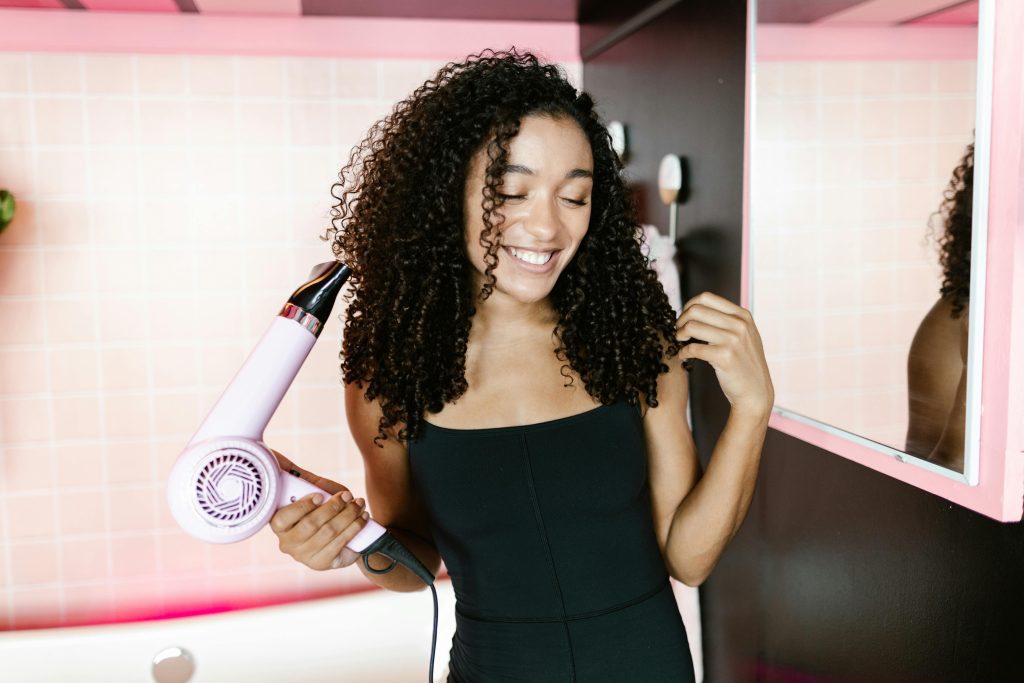
Air drying is the gentlest option, but it can leave curls undefined if you live in a humid climate or have fine hair. A diffuser attachment on a blow dryer is an excellent middle ground — it disperses airflow evenly to dry curls without blowing them apart and causing frizz. Use a low heat, high airflow setting, and hover the diffuser without moving it too much to preserve the curl clump.
Essential Products for a Home Curly Hair Routine
You don’t need a bathroom cabinet full of products — just the right ones. Here are the key categories to invest in:
- Sulfate-Free Shampoo — Cleanses scalp without stripping natural oils. Look for gentle surfactants like cocamidopropyl betaine.
- Deep Conditioner — Weekly intensive moisture treatment. Essential for restoring elasticity and reducing breakage.
- Leave-In Conditioner — Applied post-wash on damp hair as the base layer of your styling routine for lasting hydration.
- Curl Cream or Gel — Defines and holds your curl pattern. Gel provides stronger hold; cream gives a softer, more natural finish.
- Microfiber Towel — Replaces terrycloth towels that cause frizz. Gently absorbs water while protecting the curl structure.
- Wide-Tooth Comb — For detangling only when wet and conditioned. Minimizes breakage compared to fine-tooth combs or brushes.
Protecting Your Curls at Night
What you do at night is just as important as your daytime routine. Sleeping on a regular cotton pillowcase creates friction that roughens the hair cuticle, leading to frizz and breakage. Switch to a silk or satin pillowcase, or wrap your hair in a satin bonnet or scarf before bed.
A popular nighttime technique is the “pineapple” — gathering your curls loosely at the very top of your head and securing them with a gentle scrunchie. This preserves your curl shape overnight so you wake up with minimal distortion and can simply refresh your curls with a light water mist in the morning.
Common Curly Hair Mistakes to Avoid
Even with the best intentions, certain habits can work against your curls. Avoid brushing dry curly hair — it destroys the curl clump and creates a frizzy halo. Steer clear of touching your hair too much while it’s drying, as this disturbs the curl formation and introduces frizz. Don’t skip trims — curly hair ends are particularly prone to split ends and dryness, so a trim every 8–12 weeks keeps your curls looking their best. Finally, resist the urge to use heat tools without a heat protectant spray, and limit direct heat to once a week at most.
Your Best Curls Start at Home
Now that you know how to take care of your curly hair at home, start with the basics and build from there. It doesn’t have to be complicated or expensive. With a consistent routine, the right products, and a bit of love and patience, your natural curls can thrive. Start simple — master the wash, condition, and style basics — then build from there. Your curls are worth it.